Lithium orotate: the low-dose supplement that's turning heads in brain health research
⚠️ Disclaimer: This blog post is for informational purposes only and does not constitute medical advice. Always consult a qualified healthcare provider before starting any supplement, especially if you are taking medications or have existing health conditions.
What is lithium orotate — and how is it different from prescription lithium?
If you've heard of lithium, chances are it was in the context of bipolar disorder. Prescription lithium — sold as lithium carbonate or lithium citrate — has been a cornerstone treatment for bipolar disorder since the 1970s. It's effective, but it requires careful blood monitoring because therapeutic doses and toxic doses are uncomfortably close together. Side effects can include tremors, weight gain, kidney strain, and thyroid disruption.
Lithium orotate is an entirely different animal. It's a mineral supplement in which lithium is bound to orotic acid — a compound naturally produced in the body. This binding is believed to dramatically improve how efficiently lithium crosses the blood-brain barrier and is absorbed into cells, meaning it may be effective at doses many times smaller than prescription lithium.
Lithium orotate is not a replacement for prescription lithium in treating bipolar disorder. However, at low supplemental doses, it may offer a range of brain-protective and mood-supporting benefits — without the risks associated with high-dose pharmaceutical lithium.
When and to whom to recommend lithium orotate:
I make a big distinction between what I do as a physician, one-on-one, with my patients, and what I think is safe for conversations between mental health practitioners and their clients. Here’s what a mental health professional should know when talking with their clients about lithium orotate.
First, it’s not a replacement for the prescription lithium carbonate, used for managing bipolar.
Second, it’s not a magic pill to replace food, movement, sleep and healthy relationships and it should not be used if these life-style behaviors are not in place. A regular movement program, in particular, is especially important when taking lithium (or any metal supplement) as it determines how well the body can utilize it and eliminate it, which is important in avoiding negative side effects. In other words, lithium orotate is a small, extra thing people can consider, but not something to do instead of investing time and energy into caring for your body.
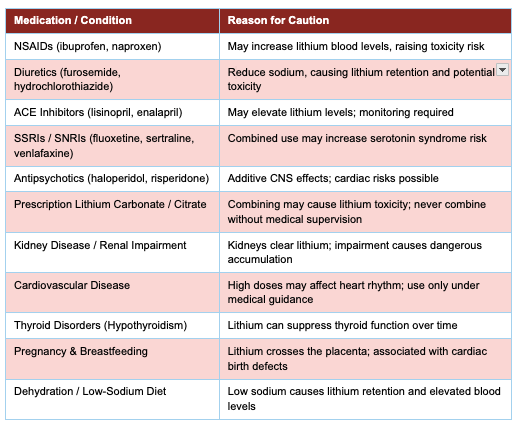
Also, the medications and conditions in the table on the right represent significant caution or outright contraindications. If you have any of these conditions and decide to try lithium orotate, it should be under guidance of your current healthcare provider.
Important context to consider before using lithium orotate
If someone is considering lithium orotate to help reduce brain inflammation, support mood, or potentially slow cognitive decline, it’s important to first look at the pillars of health [cross link to handout]. Are they exercising regularly, eating a mostly whole-foods diet, getting adequate sleep, and effectively managing stress? They should also make sure they do not have any of the contraindications listed above.
Lithium orotate should not be viewed as a substitute for these core self-care practices, but rather as something that may be considered alongside them.
When prescribing, the dosing philosophy is deliberately conservative: 1 mg or 5 mg of lithium orotate, taken 3 to 4 days per week — not daily. Intermittent use reduces the risk of accumulation and keeps the approach low-risk.
Brand quality matters, so a trusted product with consistent elemental lithium content is non-negotiable. I generally use low-dose lithium orotate from Thorne or Pure Encapsulations. Some physicians will want to monitor blood levels, particularly in more complex patients, and that caution is reasonable and worth respecting.
The most important screening step is identifying the "more is better" mindset. Patients who self-escalate doses, who are looking for a quick fix, or who are not addressing sleep, diet, or exercise are poor candidates — not because lithium orotate is dangerous, but because that pattern of thinking is dangerous.
When used by the right person, at the right dose, with realistic expectations, it can be a useful brain health strategy. And - as always - it is recommended that people share with their primary healthcare provider all over-the-counter medications they are taking.
So now that we’ve laid down the context within which to consider when and how lithium orotate is appropriate, let’s understand why there’s so much buzz...
Lithium in the water supply: what population studies tell us
One of the most fascinating — and often overlooked — areas of lithium research involves naturally occurring lithium in public drinking water. Across multiple countries and continents, researchers have found intriguing associations between trace lithium levels in municipal water and improved mental health and cognitive outcomes at the population level.
Lower suicide rates
Perhaps the most replicated finding in this field is the association between higher lithium concentrations in drinking water and significantly lower suicide rates. Studies from Japan, the United States, Greece, Austria, and the United Kingdom have all found this relationship. The effect is observed at levels far below therapeutic doses — we're talking micrograms per liter, not milligrams.
Dementia and alzheimer's protection
Population-level data also suggest that communities with higher lithium in their water have lower rates of dementia diagnoses. A landmark Danish study following over 73,000 individuals found that those exposed to higher tap water lithium levels had a measurably lower risk of developing Alzheimer's disease. Researchers theorize that chronic low-level lithium exposure may provide neuroprotective effects over decades.
Reduced violence and crime
Several studies have explored whether lithium in water correlates with lower rates of violent crime and aggression. A study of Texas counties found that areas with higher lithium levels in water had significantly lower rates of homicide, suicide, and violent crime. While correlation isn't causation, the consistency of findings across independent studies is striking.
These population observations have fueled serious scientific debate about whether low-dose lithium supplementation — mimicking what some populations naturally receive in water — could serve as a safe public health intervention for brain health.
Lithium orotate and dementia: what the research shows
One of the most exciting areas of lithium research is its potential to slow or prevent the progression of Alzheimer's disease and other forms of dementia. Lithium has been shown in laboratory and clinical settings to inhibit two key pathways implicated in Alzheimer's: the formation of amyloid-beta plaques and the hyperphosphorylation of tau proteins, both hallmarks of the disease.
Lithium inhibits an enzyme called GSK-3β (glycogen synthase kinase-3 beta), which plays a central role in tau phosphorylation. By reducing GSK-3β activity, lithium may help prevent the tangling of tau proteins inside neurons — one of the main mechanisms of Alzheimer's-related neurodegeneration.
Clinical and observational evidence for dementia
Beyond laboratory findings, human studies have added compelling evidence:
Patients with mild cognitive impairment (MCI) who were treated with low-dose lithium showed significantly slower cognitive decline and better preservation of memory function than controls.
Brazilian researchers found that Alzheimer's patients who had been on low-dose lithium for over a year showed a stabilization of cognitive scores, while the placebo group continued to decline.
The Danish population study referenced above found that individuals with higher exposure to lithium in drinking water over decades had a statistically significant reduction in Alzheimer's diagnoses.
Lithium orotate and mental health: condition-by-condition overview
Lithium has a broad impact on several neurotransmitter systems including serotonin, dopamine, glutamate, and GABA. At low doses, lithium orotate may provide mild but meaningful support across a range of psychiatric conditions. Below is a brief review of the evidence for each.
Depression
Lithium has decades of clinical evidence as an augmentation strategy for treatment-resistant depression when added to antidepressants. Low-dose lithium orotate may help stabilize mood and support serotonergic function, offering a gentler adjunctive option for individuals with depressive symptoms who are not on prescription medications.
Anxiety
Lithium modulates glutamate activity — the brain's primary excitatory neurotransmitter — which may help reduce excessive neural firing associated with anxiety states. Some users and clinicians report that low-dose lithium orotate promotes a sense of calm and emotional steadiness, potentially useful for generalized anxiety.
ADHD
Preliminary research and anecdotal reports suggest lithium may improve impulse control and emotional regulation in individuals with ADHD by influencing dopaminergic signaling in the prefrontal cortex. It is not a first-line treatment and should not replace established ADHD therapies, but it may serve as a complementary support tool.
PTSD
Emerging evidence suggests lithium's neuroprotective properties — particularly its ability to promote neurogenesis and reduce oxidative stress in the hippocampus — may be relevant to trauma-related disorders like PTSD. Some researchers theorize that lithium may help normalize the stress-response circuitry disrupted by trauma, though clinical trials specifically targeting PTSD with lithium orotate are still in early stages.
Final thoughts
Lithium orotate occupies a fascinating middle ground between everyday nutritional supplementation and serious neurological medicine. The science — from population water studies to clinical dementia trials — is building a compelling case that trace lithium has a meaningful role in brain health.
Patient selection is everything. The best candidates are those who do not regularly use NSAIDs, have no kidney disease, and are not managing multiple medications. Just as importantly, they should already be doing the foundational work — regular movement, a whole-foods diet, and ongoing learning — because lithium orotate complements a brain-healthy lifestyle rather than replacing it.
References
Fajardo VA, Fajardo VA, LeBlanc PJ, MacPherson REK. Examining the Relationship between Trace Lithium in Drinking Water and the Rising Rates of Age-Adjusted Alzheimer's Disease Mortality in Texas. J Alzheimers Dis. 2018;61(1):425-434. doi: 10.3233/JAD-170744. PMID: 29103043; PMCID: PMC7592673.
Kessing LV, Søndergård L, Forman JL, Andersen PK. Lithium treatment and risk of dementia. Arch Gen Psychiatry. 2008 Nov;65(11):1331-5. doi: 10.1001/archpsyc.65.11.1331. PMID: 18981345.
Memon A, Rogers I, Fitzsimmons SMDD, Carter B, Strawbridge R, Hidalgo-Mazzei D, Young AH. Association between naturally occurring lithium in drinking water and suicide rates: systematic review and meta-analysis of ecological studies. Br J Psychiatry. 2020 Dec;217(6):667-678. doi: 10.1192/bjp.2020.128. PMID: 32716281.
Nunes MA, Viel TA, Buck HS. Microdose lithium treatment stabilized cognitive impairment in patients with Alzheimer's disease. Curr Alzheimer Res. 2013 Jan;10(1):104-7. doi: 10.2174/1567205011310010014. PMID: 22746245.
Strawbridge R, Kerr-Gaffney J, Bessa G, Loschi G, Freitas HLO, Pires H, Cousins DA, Juruena MF, Young AH. Identifying the neuropsychiatric health effects of low-dose lithium interventions: A systematic review. Neurosci Biobehav Rev. 2023 Jan;144:104975. doi: 10.1016/j.neubiorev.2022.104975. Epub 2022 Nov 24. PMID: 36436738.
⚠️ Disclaimer: This blog post is for informational purposes only and does not constitute medical advice. Always consult a qualified healthcare provider before starting any supplement, especially if you are taking medications or have existing health conditions.